CREATE Foundation's Victorian Election Priorities
Prioritising children and young people with out-of-home care experience
Victoria is heading to the polls on 28 November 2026 at an important time for the state’s child protection and out-of-home care system. Significant reforms are underway, but children and young people in care continue to face significant challenges across their lives and into adulthood.
As of 30 June 2025, 9,353 children were in out-of-home care in Victoria. These children and young people need a system that takes greater responsibility for their safety, wellbeing and long-term outcomes.
Victoria has taken an important step towards this through the introduction of Corporate Parenting. The Victorian Government is the first in Australia to enshrine a corporate parenting framework, through the passing of Children, Youth and Families Amendment (Supporting Stable and Strong Families) Act 2026 which requires all government departments and ministers in different portfolios to take responsibility for the wellbeing and outcomes of children and young people in care and care leavers up to the age of 25.
The next Victorian government must build on this progress by making the corporate parenting accountable, ensuring the rights, wellbeing and futures of children and young people with a care experience remain a priority and putting their voices and authentic participation at the heart of decisions that affects their lives.
Election Ask 1
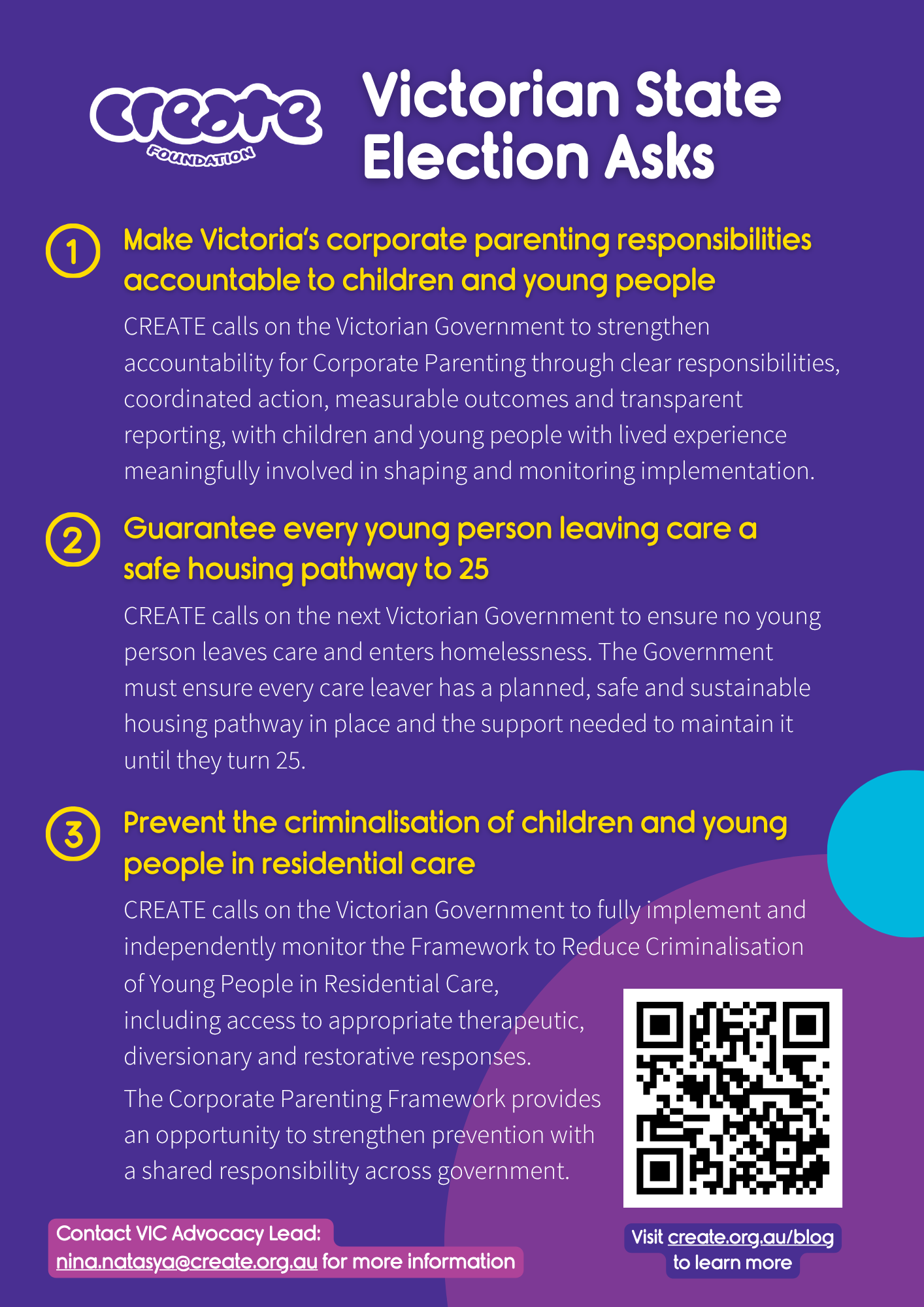
Make Victoria's new whole-of-government parenting responsibilities accountable to young people
Corporate parenting recognise the government has a shared responsibility to support children and young people across all aspects of their lives, including housing, health, education, mental health, employment, and youth justice interactions. Victoria’s commitment to establishing whole-of-government responsibility through a legislation is an important step forward. But the reforms are a commitment to change, not the change itself. The next step is ensuring they are effectively implemented and deliver better outcomes for children and young people with care experience.
The success of corporate parenting will depend on how these responsibilities are implemented in practice.
Government agencies need to work together, have clear responsibilities and be accountable for delivering measurable improvements in outcomes for children and young people. Children and young people with care experience must also have an ongoing and meaningful role in shaping, monitoring and holding government accountable for implementation - not simply being consulted at particular stages of reform.
Corporate parenting must move beyond policy commitments and demonstrate tangible improvements in the everyday lives of children and young people in care. Ultimately, success should be measured not by the existence of a framework, but by whether children and young people experience better access to education, housing, health, wellbeing, and lifelong support as a result of government action.
CREATE calls on the next Victorian Government to:
- Establish a standing, paid mechanism for children and young people with care experience, including Aboriginal and Torres Strait Islander young people, to meaningfully participate in the implementation of Corporate Parenting.
- Establish a cross-government Corporate Parenting coordination mechanism to identify and address issues requiring action across portfolios, ensuring Corporate Parent agencies work together to support the needs of children and young people rather than operating through separate Action Plans.
- Ensure Corporate Parenting Action Plans are measurable and accountable, with clear actions, responsible agencies, timeframes and outcomes, and regular monitoring.
- Support corporate parent agencies to embed Corporate Parenting into practice through practical guidance, training and shared learning so agencies understand what Corporate Parenting means for their policies, services and everyday practice.
- Require government to demonstrate how children and young people's input has influenced decisions and led to changes in policy, services and practice.
Election Ask 2
Guarantee every young person leaving care a safe housing pathway to 25
Young people leaving care face a significantly higher risk of homelessness than their peers. CREATE's research in 2020 found that 17% of young people were homeless immediately after leaving care, rising to 30% within their first year. Key barriers include limited availability and diversity of appropriate housing, long social housing waiting lists, and insufficient financial and emotional support.
Victoria has established important programs to support young people leaving care, including Home Stretch, Better Futures and Housing First for Young People Leaving Care. These programs provide important financial, casework, housing and tenancy support. However, these initiatives primarily provide transition support and do not, on their own, resolve the structural shortage of affordable and social housing or guarantee a sustainable housing pathway for every care leaver.
CREATE welcomes current Victorian government’s investment in the 2026-2027 Budget which includes the expansion of Social Housing Growth Fund. However, care leavers are not clearly identified as a priority cohort within these broader housing and homelessness responses. There is an opportunity to connect Victoria's existing leaving-care supports with its broader housing system and ensure that young people leaving care can access appropriate housing before they reach crisis point.
Victoria's new whole-of-government responsibility for care leavers under 25 provides a further opportunity to strengthen this response. Corporate parenting should mean that government does not simply support a young person to transition from care but remains responsible for ensuring they can access the housing and support they need to establish a safe and stable adulthood.
CREATE is particularly concerned about what happens when a young person's initial housing arrangement does not work, or when time-limited leaving-care support ends. A care leaver should not be left to navigate homelessness services or the mainstream housing system alone simply because they have reached a particular age or exited a particular program.
CREATE calls on the next Victorian Government to ensure no young person leaves care and enters homelessness. The government must be responsible for ensuring:
- Every young person leaves care with a secure housing pathway. Every young person should have an appropriate housing arrangement secured before leaving care, or a clear pathway to obtaining one, with an identified service responsible for support and contingency arrangements until they turn 25.
- Every young person receives a timely transition-to-adulthood plan, commencing at least two years before their planned exit from care, to support the development of living skills and prepare them for independent adulthood.
- A Care Leaver Housing Pathways Protocol is established. Develop a state-wide protocol through Corporate Parenting Action Plans that sets out clear responsibilities for housing and support for care leavers until age 25.
- Priority housing pathways for care leavers is established. Recognise young people leaving care as a priority cohort for appropriate social, affordable and supported housing, with clear referral pathways into available options.
- Housing outcomes for care leavers are measured and publicly reported on. Set a measurable target to reduce homelessness among young people leaving care and report annually on homelessness, housing stability and housing breakdown.
Election Ask 3
Prevent the criminalisation of children and young people in residential care
Children living in residential care continue to experience high levels of contact with the criminal justice system. Victoria Legal Aid found that between 2019 and 2022, 42% of its child clients living in residential care became involved with the criminal justice system within 12 months, rising to 51.3% within two years.
The Victorian Government established the Framework to Reduce Criminalisation of Young People in Residential Care in 2020, setting out a shared commitment across government, Victoria Police and residential care providers to reduce the unnecessary criminalisation of children in residential care.
However, children and young people in residential care continue to experience contact with police and the criminal justice system. The Commission for Children and Young People has also identified the need for further effort to ensure the Framework and its associated action plan are implemented effectively and have a meaningful impact on reducing children’s contact with the criminal justice system.
There are also gaps in how Child Protection and Youth Justice work together for children involved in both systems, including coordination, information sharing, joint case planning and clear accountability. Children in residential care need government agencies to work together to address their underlying needs and provide appropriate support before behaviour escalates to police or Youth Justice involvement.
The new corporate parenting reforms provide an opportunity to strengthen this approach by making the prevention of criminalisation a shared responsibility across the government agencies working with children and young people in care. Corporate parenting should ensure that agencies work together to prevent children in residential care from being drawn further into the criminal justice system, rather than responding only once a crisis occurs.
The next Victorian Government must commit to:
- Fully implement and independently monitor the Framework to Reduce Criminalisation of Young People in Residential Care, ensuring appropriate therapeutic, diversionary and restorative responses are available before police involvement where there is no immediate safety risk.
- Strengthen coordination between Child Protection, Youth Justice, Victoria Police and residential care services, including through stronger joint case planning and clear roles and escalation pathways.
- Give children and young people with care experience a formal role in shaping and evaluating youth justice prevention and diversion responses.
- Expand access to sustained mentoring and community connections for young people in residential care, building on existing Better Futures Community Connections and other mentoring program. This should include cultural connections and opportunities to participate in community activities.
- Publicly report on progress and outcomes, including police contact, charges and Youth Justice involvement among children living in residential care.
Young person 1-page summary
Contact Nina Natasya at advocacy@create.org.au for more information.